The Chakras and the Kundalini
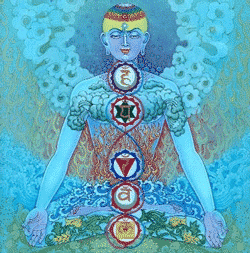
The Chakras are sacred centres which act as pathways to different dimensions of experience.
The word Chakra means wheel in Sanskrit, which refers to the ever spinning vortices of energy that they are.
The seven main chakras are described as being aligned in an ascending column from the base of the spine to the top of the head. Each chakra is associated with a certain color, multiple specific functions, an aspect of consciousness, a classical element, and other distinguishing characteristics.
The chakras are thought to vitalise the physical body and to be associated with interactions of both a physical and mental nature. They are considered loci of life energy, or prana, which is thought to flow among them along pathways/psychic channels called nadis.
The chakras are described in the tantric texts in which they are described as an energy which comes down from the spiritual and gradually crudifies, creating distinct levels of energy, and which eventually find rest in the Muladhara chakra.
Muladhara
is the base from which the 3 main psychic channels or nadis -ida,
pingala and sushumna- emerge. It is related to the physical
processes of reproduction and excretion, and also to the various fear
and guilt complexes associated with them. All a person's potential
karma are said to be expressed here.
The Kundalini lies coiled and sleeping, and it is the purpose of a tantric yogi to arouse this energy, and cause it to rise back up through the increasingly subtler chakras, until union with god is achieved in the Sahasrara chakra at the crown of the head.
A sequential overview of the Seven Basic Chakras
Sahasrara Chakra
The highest crown chakra is said to be the chakra of consciousness, the
master chakra that controls all the others. Its role would be very
similar to that of the pituitary gland, which secretes hormones to
control the rest of the endocrine system, and also connects to the
central nervous system via the hypothalamus. The thalamus is thought to
have a key role in the physical basis of consciousness.
Ajna Chakra
The Ajna Chakra, or third eye, is linked to the pineal gland.
Ajna is the chakra of time and awareness and of light. The pineal gland
is a light sensitive gland, that produces the hormone melatonin, which
regulates the instincts of going to sleep and awakening. It also
produces trace amounts of the psychedelic chemical dimethyltryptamine.
Vishuddha Chakra
The throat chakra, Vishuddha, is said to be related to
communication and growth, growth being a form of expression. This
chakra is paralleled to the thyroid, a gland that is also in the
throat, and which produces thyroid hormone, responsible for growth and
maturation.
Anahata Chakra
The heart chakra, Anahata, is related to love, equilibrium, and
well-being. It is related to the thymus, located in the chest. This
organ is part of the immune system, as well as being part of the
endocrine system. It produces T cells responsible for fighting off
disease, and is adversely affected by stress.
Manipura Chakra
The solar plexus chakra, Manipura, is related to energy, assimilation and digestion, and is said to correspond to the roles played by the pancreas and the outer adrenal glands, the adrenal cortex. These play a valuable role in digestion, the conversion of food matter into energy for the body.
Svadhistanna Chakra
The sacral chakra, Swadhisthanna, is located in the groin, and
is related to emotion, sexuality and creativity. This chakra is said to
correspond to the testes or the ovaries, that produce the various sex
hormones involved in the reproductive cycle, which can cause dramatic
mood swings.
Muldhara Chakra
The base or root chakra, Muludhara, is related to security,
survival and also to basic human potentiality. It is said the kundalini
lies coiled here, ready to uncoil and bring man to his highest
spiritual potential in the crown chakra.
This center is located in the region between the genitals and the anus.
Although no endocrine organ
is placed here, it is said to relate to the inner adrenal glands, the
adrenal medulla, responsible for the fight and flight response when
survival is under threat. In this region is located a muscle that
controls ejaculation in the sexual act.
A parallel is drawn between the sperm cell and the ovum, where the genetic code lies coiled, and the legendary ready to express itself as a fully developed human being.
